Updated October 21, 2026
Short answer: Yes, a tea can match or beat a cup of coffee, depending on how much leaf you use. Guayusa leaves from wild trees have been measured at up to about 7.6% caffeine, and a teaspoon of our Guayusa Powder has about 120 mg, within the FDA's 113–247 mg range for a 12 oz cup of brewed coffee.
At a glance
- Per the FDA, a 12 oz cup of brewed coffee has about 113–247 mg of caffeine; black tea about 71 mg and green tea about 37 mg.
- Guayusa leaves from wild trees have been measured at up to about 7.6% caffeine, among the highest levels ever reported for a leaf; cultivated leaves usually measure about 1.5–3.2%.
- Per cup, what matters most is how much leaf you use, how long you steep it and whether you consume the whole leaf.
- A guayusa serving can match a lighter cup of coffee: from ~82 mg (5 g tea bag) to ~120 mg (1 tsp of Guayusa Powder).
Start here: everything about the leaf, from taste to caffeine to brewing, is in our complete guayusa tea guide.
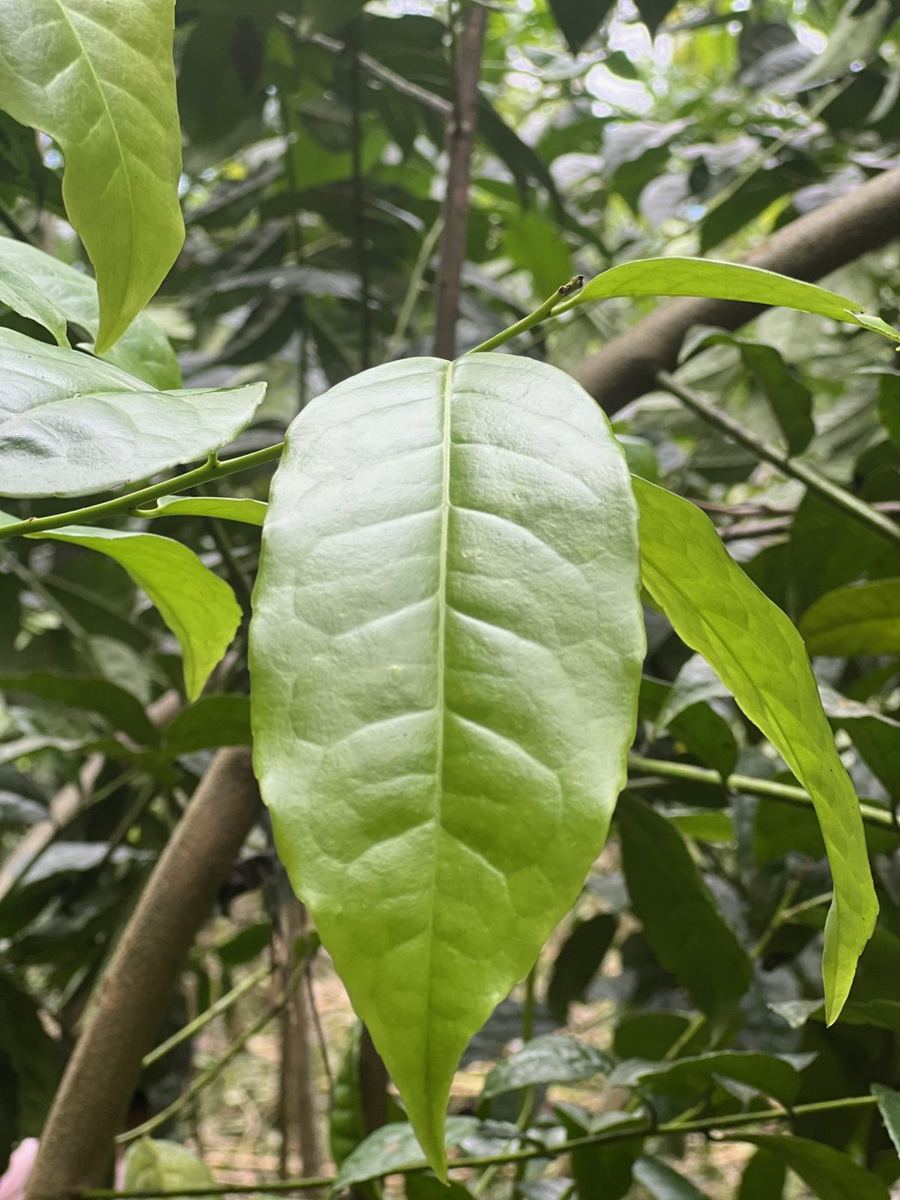
Search for the tea with the most caffeine and one leaf keeps coming up: guayusa. Leaves from wild guayusa trees have been measured at up to about 7.6% caffeine, among the highest levels ever reported for a leaf.
But the number in the leaf is only half the story. What ends up in your cup depends on the leaf, how it's processed and how you brew it.
Here's what the numbers say about whether there's a tea with more caffeine than coffee.
The short answer
Yes, a tea serving can match or beat a cup of coffee. Guayusa's leaf can be exceptionally rich in caffeine, but in the cup it comes down to dose: how many grams of leaf go into your cup, how long they steep, and whether you drink the whole leaf (like matcha or a powder) or just an infusion.
Gram for gram, guayusa leaves from wild trees can far exceed tea leaves, while cultivated guayusa sits closer to green tea and matcha. A strong serving of any of them can rival a lighter cup of coffee. A very strong coffee is still hard to beat.
How much caffeine is in coffee and tea? (FDA figures)
The FDA lists typical caffeine content for a 12 oz drink:
- Brewed coffee: 113–247 mg
- Black tea: 71 mg
- Green tea: 37 mg
- Energy drinks: 41–246 mg
Most tea cups are smaller. Scaled down to an 8 oz cup, that's roughly 75–165 mg for coffee, about 47 mg for black tea and about 22 mg for green tea. Notice how wide the coffee range is: the "coffee" you're comparing against could be mild or very strong.
Up to 7.6%: where guayusa's caffeine figure comes from
Guayusa (Ilex guayusa) is a caffeinated holly from the Amazon, a cousin of yerba mate. Ethnographic research describes the Achuar people drinking a strong guayusa decoction at dawn as a stimulant, with traditional practices to avoid having too much (Lewis et al., 1991).
A 2025 scientific review of guayusa sums up the range. Leaves from wild guayusa trees can reach up to about 7.57% caffeine, while the traditional preparation, boiling the leaves for an hour, yields around 3%. Analyses of cultivated, dried leaves usually land at about 1.5% to 3.2% (one 2023 analysis found 2.27%).
Why such a wide range? Wild versus cultivated trees, the age of the leaf, how it's dried and how the caffeine is extracted in the lab all change the result. That's also why we always give our own figures as approximate: every harvest is a little different.
Gram for gram: guayusa vs green tea vs matcha
So how does guayusa compare with tea from Camellia sinensis? A 2021 review of matcha by Kochman and colleagues reports:
| Leaf | Caffeine per gram of dry leaf | Source |
|---|---|---|
| Guayusa | ~15–32 mg/g (about 1.5–3.2%) | Molecules 2024; Cadena-Carrera 2023 |
| Green tea | 11.3–24.7 mg/g | Kochman et al., 2021 |
| Matcha | 18.9–44.4 mg/g | Kochman et al., 2021 |
| Coffee beans (for comparison) | 10–12 mg/g | Kochman et al., 2021 |
Two surprises here. First, guayusa sits in the same league as green tea and matcha. It tends to land at the higher end of green tea, but matcha's upper range is higher still. Second, coffee beans are not especially high in caffeine per gram. Coffee wins per cup because a brew uses a generous amount of grounds and extracts a lot of what's in them.
So if you're asking for the highest caffeine tea by the leaf alone, there's no clear single winner. Ranges overlap, and growing conditions, leaf age and processing all matter.
Why the cup matters more than the leaf
Three things decide how much caffeine actually ends up in your mug.
1. Grams of leaf
This is the biggest factor. A 1.5 g tea bag and a 5 g tea bag of the same guayusa are very different drinks. Double the leaf and you roughly double the caffeine available.
2. Steep time and temperature
Caffeine dissolves into hot water over time. A quick 2-minute dunk extracts less than a 5–10 minute steep in boiling water. That's why our brewing guide says: for a stronger cup, use more leaf or steep longer.
3. Infusion vs whole leaf
When you steep leaves and strain them, some caffeine stays behind in the leaf. When you drink the whole leaf, as with matcha or a powder blended into a smoothie, you get all of it. That's the main reason matcha has a reputation as the most caffeinated tea: you're consuming the leaf, not just an infusion.
How PACHA guayusa compares with coffee, per serving
Here are approximate caffeine figures per serving from our product pages, next to the FDA's coffee and tea figures. Natural leaf varies from harvest to harvest, so treat them as estimates.
| Drink | Serving | Caffeine (approx.) |
|---|---|---|
| Guayusa Loose Leaf (Traditional) | 4 g | ~66 mg |
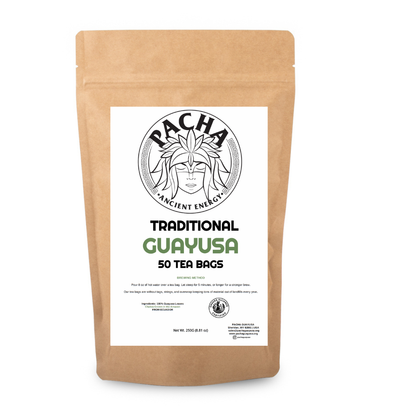
| Guayusa Tea Bags, 50 ct | 1 bag (5 g) | ~82 mg |
| Guayusa Extra Fine | 2 tsp (~8 g) | ~115 mg |
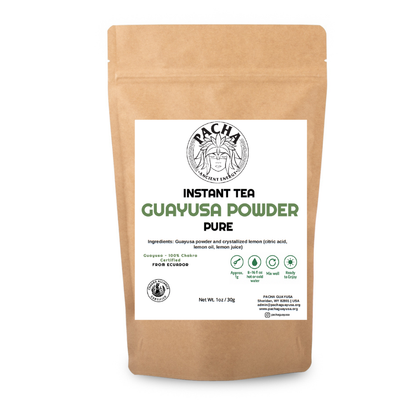
| Guayusa Powder | 1 tsp (~6 g) | ~120 mg |
| Brewed coffee (FDA) | 12 oz | 113–247 mg |
| Brewed coffee (FDA, scaled) | 8 oz | ~75–165 mg |
| Black tea (FDA) | 12 oz | 71 mg |
| Green tea (FDA) | 12 oz | 37 mg |
What this shows:
- A 5 g guayusa tea bag (~82 mg) is in the range of a lighter 8 oz cup of coffee and above a 12 oz black tea.
- Extra Fine (~115 mg per 2 tsp) and Guayusa Powder (~120 mg per teaspoon) reach the low end of a 12 oz coffee. Powder is whole leaf, so like matcha you consume all of its caffeine.
- A strong coffee-shop brew can still go well past any of these.
So the honest conclusion: yes, a guayusa serving can match or exceed a cup of coffee, depending on the format and the coffee. It's not because guayusa is magic. It's because you can choose a bigger dose of leaf.
For product-by-product detail, see our full guide to guayusa caffeine content.
Does more caffeine mean a better cup?
Not necessarily. Many guayusa drinkers describe its lift as smoother and steadier than coffee. That's a common experience, not a guarantee; everyone responds to caffeine differently. Guayusa also contains a little theobromine and chlorogenic acids, and it's commonly described as containing L-theanine. Research on guayusa in people is still limited, so we don't make promises about what these compounds do.
If you're comparing caffeinated leaves, our guayusa vs yerba mate guide covers flavor and ritual too. New to the plant? Start with what is guayusa.
Keep your total in check
The FDA cites 400 mg a day as an amount not generally associated with negative effects for most adults, and notes that sensitivity varies widely. Two servings of Guayusa Powder plus an energy drink adds up fast, so count every source.
If you're pregnant, trying to become pregnant or breastfeeding, take medication, have a heart condition or are sensitive to caffeine, talk to your doctor first. More in is guayusa safe?
Find your strength
Want a coffee-level cup from a leaf? Try Guayusa Extra Fine for a bold brewed cup, Guayusa Tea Bags (50 ct) for an easy morning swap, or Guayusa Powder for smoothies and lattes. All of it is 100% guayusa leaf from small-scale farmers in Archidona, Napo province, air-dried and never smoked.
Want the strongest cup? Compare our guayusa tea bags and loose leaf guayusa by caffeine per serving.
Keep reading: Guayusa vs Guarana · Guayusa vs Black Tea · Why Does Matcha Have So Much Caffeine?
Frequently Asked Questions
Is there a tea with more caffeine than coffee?
Per gram of leaf, wild guayusa has been measured at up to about 7.6% caffeine, and per serving, yes, a tea can match or beat a cup of coffee. It depends on how much leaf you use and whether you drink the whole leaf. A PACHA 5 g guayusa tea bag has about 82 mg and a teaspoon of Guayusa Powder about 120 mg, while the FDA puts 12 oz of coffee at 113–247 mg.
What tea has the most caffeine?
Per gram of leaf, guayusa holds one of the highest figures ever reported: up to about 7.6% caffeine in leaves from wild trees, though cultivated leaves usually measure about 1.5–3.2%. Lab reviews put green tea at 11.3–24.7 mg/g and matcha at 18.9–44.4 mg/g. Per cup, the amount of leaf and steep time matter most.
Is guayusa the most caffeinated leaf in the world?
It's among the most caffeinated leaves ever measured: leaves from wild guayusa trees have reached up to about 7.6% caffeine. Cultivated, dried leaves usually measure about 1.5–3.2%, similar to green tea and matcha. Per cup, a generous serving of guayusa can rival a cup of coffee.
Does guayusa have more caffeine than green tea?
Per cup, usually yes. The FDA puts 12 oz of green tea at about 37 mg, while a 4 g serving of PACHA Traditional guayusa has about 66 mg. Per gram of dry leaf, guayusa tends to sit at the higher end of green tea's range. Your actual cup depends on how much leaf you use and how long you steep it.
How can I make guayusa stronger?
Use more leaf or steep longer. For loose leaf, use 2 heaping teaspoons in 8 oz of boiling water and steep 5–10 minutes, adding time or leaf for a stronger cup. Extra Fine gives about 115 mg per 2 teaspoons, and Guayusa Powder about 120 mg per teaspoon. Keep your daily total in mind and talk to your doctor if you're sensitive to caffeine.
Sources
- Noriega P., et al. (2025). "Guayusa (Ilex guayusa Loes.) Ancestral Plant of Ecuador: History, Traditional Uses, Chemistry, Biological Activity, and Potential Industrial Uses." Molecules 30(13):2837 (up to 7.57% caffeine in leaves from wild trees; about 3% after the traditional 1-hour boil; citing Lewis et al. 1991 and Negrin et al. 2019) — https://doi.org/10.3390/molecules30132837
- U.S. Food and Drug Administration, "Spilling the Beans: How Much Caffeine Is Too Much?" (content current as of 08/28/2024) — https://www.fda.gov/consumers/consumer-updates/spilling-beans-how-much-caffeine-too-much
- Kochman J., Jakubczyk K., Antoniewicz J., Mruk H., Janda K. (2021). "Health Benefits and Chemical Composition of Matcha Green Tea: A Review." Molecules 26(1):85 — https://doi.org/10.3390/molecules26010085
- Meneses M.Á., et al. (2024). "Green Processing of Ilex guayusa: Antioxidant Concentration and Caffeine Reduction Using Encapsulation by Supercritical Antisolvent Process." Molecules 29(22):5309 — https://doi.org/10.3390/molecules29225309
- Cadena-Carrera S., et al. (2023). "Green-based methods to obtain bioactive compounds from Ilex guayusa Loes. using polar solvent." Natural Product Research 37(18):3103-3108 — https://doi.org/10.1080/14786419.2022.2140802
- Wise G., Negrin A. (2020). "A critical review of the composition and history of safe use of guayusa." Critical Reviews in Food Science and Nutrition 60(14):2393-2404 — https://doi.org/10.1080/10408398.2019.1643286
- Lewis W.H., Kennelly E.J., et al. (1991). "Ritualistic use of the holly Ilex guayusa by Amazonian Jívaro Indians." Journal of Ethnopharmacology 33(1-2):25-30 — https://doi.org/10.1016/0378-8741(91)90156-8