At a glance
- Black tea is the oxidized leaf of Camellia sinensis; guayusa is Ilex guayusa, an Amazonian holly that is dried without black tea's long oxidation, and never smoked.
- Per the FDA, a 12 oz cup of black tea has about 71 mg of caffeine.
- Our guayusa ranges from about 41 mg (100 ct tea bag) to about 82 mg (50 ct tea bag) and about 115 mg (2 tsp of Extra Fine).
- Black tea is malty and brisk; guayusa is earthy and smooth. Both work with or without milk.
Start here: everything about the leaf, from taste to caffeine to brewing, is in our guayusa tea guide.
For millions of Americans, the day starts with a mug of black tea: English breakfast, a strong Assam, maybe a splash of milk. If you're looking for something new, or a coffee alternative tea that still wakes you up, guayusa is worth a look.
We're PACHA, and we bring guayusa from the Ecuadorian Amazon. Here's a fair comparison of guayusa vs black tea: how each is made, how they taste, how much caffeine they have and how to swap one for the other.
The Short Answer
- Black tea comes from Camellia sinensis, the same plant as green tea. The difference is processing: black tea leaves are allowed to oxidize, which turns them dark and gives the cup its color and briskness.
- Guayusa comes from Ilex guayusa, a holly tree from the upper Amazon and a cousin of yerba mate. It's a different plant altogether.
- Per serving, guayusa can sit below, around or above a cup of black tea, depending on which format you choose.
Two Different Plants
Black, green, oolong and white teas all come from one species, Camellia sinensis. What separates them is how the leaf is handled after picking.
Guayusa isn't a tea in that botanical sense. It belongs to the holly family (Aquifoliaceae), along with yerba mate. In Ecuador's Amazon, families have long gathered before dawn to share it. Today we work with small-scale farmers in Archidona, Napo province, who grow it in the traditional chakra system, in the shade of a diverse forest.
How Each Leaf Is Made
Black tea: oxidation is the key step
A 2022 review (Abudureheman et al.) describes black tea production as plucking, withering, rolling, fermentation and drying. "Fermentation" here really means oxidation: once the leaves are rolled, the leaf's own enzymes convert its catechins into new compounds, mainly theaflavins (orange-red) and thearubigins (red-brown). That's where black tea gets its dark color and much of its flavor.
Guayusa: withered and dried, never smoked
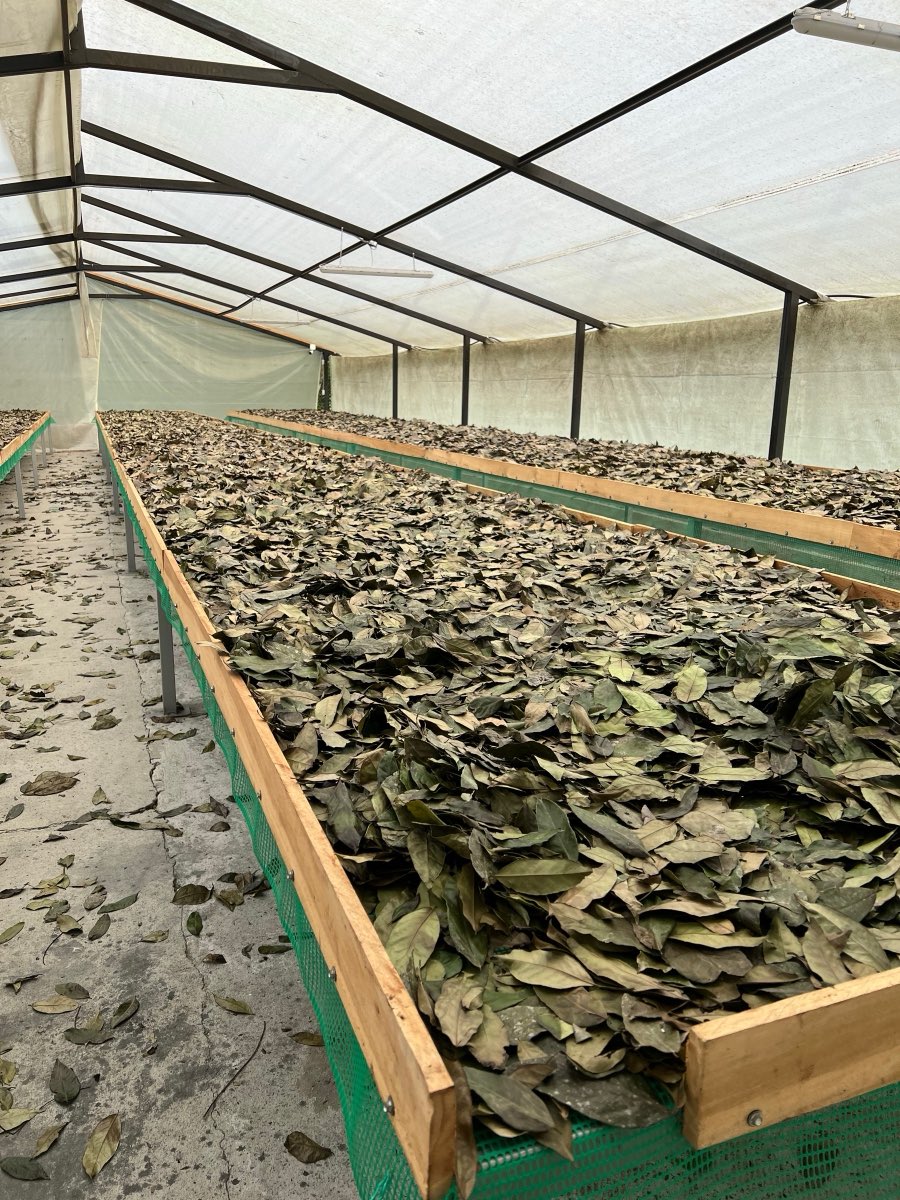
Our guayusa leaves are selected and picked by hand, then withered (for our Traditional and Green styles), air-dried and oven-dried, cut and packed in small batches. They're never smoked. There's no long oxidation stage like black tea's, so the leaf keeps an earthy, green-brown character rather than turning black.
Comparison Table: Guayusa vs Black Tea
| Black tea | Guayusa (PACHA) | |
|---|---|---|
| Plant | Camellia sinensis (tea plant) | Ilex guayusa (Amazonian holly) |
| Processing | Withered, rolled, oxidized ("fermented"), dried | Hand-picked, withered (Traditional, Green) or not (Golden), air- and oven-dried, never smoked |
| Key flavor compounds | Theaflavins and thearubigins | Chlorogenic acids are the main phenolic compounds |
| Flavor | Malty, brisk, bold | Earthy, smooth, lightly floral, slightly sweet |
| Caffeine | ~71 mg per 12 oz (FDA) | ~41 mg (100 ct bag), ~82 mg (50 ct bag), ~115 mg (2 tsp Extra Fine) |
| Milk and sugar | Classic with milk; plain also common | Usually enjoyed plain; milk or honey are up to you |
| Brewing | Hot water, a few minutes | Boiling or hot water, about 5–10 minutes |
Flavor: Malty and Brisk vs Earthy and Smooth
Black tea is bold and often described as malty or brisk. A 2015 study (Bhuyan et al.) notes that theaflavins and thearubigins are largely responsible for black tea's briskness, brightness, strength and color.
Guayusa tastes earthy and smooth. Our Traditional leaf has medium earthiness, a pleasant bitterness, light floral notes and a touch of sweetness. Our Extra Fine cut is more intense: deeply earthy, with a stronger but pleasant bitterness, closer to the full-bodied mug a black tea lover expects.
What about tannins and astringency?
"Tannins" is often used loosely online. What the research clearly supports is that black tea's oxidized polyphenols, the theaflavins and thearubigins, shape its brisk, mouth-drying character. Guayusa's main phenolic compounds are different: a 2017 study (García-Ruiz et al.) identified chlorogenic acid and quercetin-3-O-hexoside as the leading ones. Many drinkers describe guayusa as smooth, but taste is personal, so the best test is a cup of each.
Guayusa Caffeine vs Black Tea
Black tea caffeine
The FDA puts a 12 oz cup of black tea at about 71 mg of caffeine (roughly 47 mg per 8 oz). For comparison, it lists green tea at about 37 mg and brewed coffee at about 113–247 mg per 12 oz. Real cups vary with the tea, how much you use and how long you steep it.
Guayusa caffeine, by format
Per laboratory analysis, approximate figures for our guayusa:
- Guayusa Tea Bags (100 ct): 2.5 g of leaf, about 41 mg per bag. Lighter than a typical black tea.
- Guayusa Tea Bags (50 ct): 5 g of leaf, about 82 mg per bag. In the same range as, or a bit above, a 12 oz black tea.
- Guayusa Extra Fine: about 115 mg per 2 teaspoons (~8 g). Closer to the lower end of a cup of coffee.
Caffeine varies from batch to batch of leaf, so treat every figure as approximate. Gram for gram, cultivated guayusa leaf contains roughly 1.5–3.2% caffeine by dry weight (leaves from wild trees have been measured at up to about 7.6%), according to published analyses summarized in a 2024 study (Meneses et al.). For the full breakdown, see guayusa caffeine content and is there a tea with more caffeine than coffee?
Does guayusa feel different?
Caffeine is the same molecule in every plant. A 2019 review of natural caffeine sources (Schuster & Mitchell), which included guayusa and tea, concluded that other compounds in these drinks appear to shape how caffeine affects mood and attention, but stressed that more research is needed. One of the authors worked at PepsiCo R&D. Many drinkers describe guayusa's lift as smooth and steady; everyone responds to caffeine differently. More in the best tea for focus.
Milk, Sugar and Morning Habits
Black tea is famous with milk, and plenty of people add sugar too. Guayusa is most often enjoyed plain, because its earthy, slightly sweet flavor doesn't need much help. If you love a creamy mug, try a splash of milk or a little honey in a strong cup of guayusa and see what you think. There's no wrong way to drink it.
How to Swap Your Morning Black Tea for Guayusa
- Match your strength. If your usual mug is one black tea bag, start with one 50 ct Guayusa Tea Bag (about 82 mg). If you prefer something lighter, use the 100 ct bags (about 41 mg).
- Steep a little longer. Use 8 oz of hot water and steep about 5 minutes, or longer for a stronger cup. Loose leaf: 2 heaping teaspoons in 8 oz of boiling water, 5–10 minutes.
- Go bold with Extra Fine. If you drink strong breakfast blends, a 2-teaspoon scoop of Extra Fine (about 115 mg) gives a full-bodied cup.
- Try it iced. Like black tea, guayusa makes a good iced tea or cold brew. See how to make guayusa tea.
- Keep your total in mind. If you're replacing black tea with a stronger guayusa format, your daily caffeine may go up.
Side Effects: It's About the Caffeine
With either drink, the thing to watch is caffeine. The FDA lists signs of too much caffeine such as a faster heart rate, jitters, anxiety, sleep problems, upset stomach and headache, and notes that sensitivity varies widely. For most healthy adults, it cites about 400 mg a day as an amount not generally associated with negative effects. Keep later cups light. If you're pregnant, nursing, on medication, have a heart condition or are sensitive to caffeine, talk to your doctor. More in is guayusa safe? and guayusa tea benefits.
Which Should You Choose?
- You love a malty, brisk mug with milk: black tea.
- You want an earthy, smooth leaf and flexible caffeine levels: guayusa.
- You want a coffee alternative tea with a bit more kick than black tea: Guayusa Tea Bags (50 ct) or Extra Fine.
Comparing other leaves? Read guayusa vs green tea and guayusa vs matcha.
Where to start
- Black-tea strength: Guayusa Tea Bags (50 ct), 5 g bags with about 82 mg of caffeine each. No tags, strings or individual wrappers.
- The lighter daily cup: Guayusa Tea Bags (100 ct), about 41 mg of caffeine per bag.
- For strong breakfast-tea fans: Guayusa Extra Fine, intense and earthy, about 115 mg of caffeine per 2 teaspoons.
Ready for a new morning mug? Browse our guayusa tea bags or our loose leaf guayusa.
Keep reading: The Best Coffee Alternatives With Caffeine · Yerba Mate vs Coffee · Guayusa Herbal Tea Recipes
Frequently Asked Questions
Does guayusa have more caffeine than black tea?
It depends on the format. The FDA puts 12 oz of black tea at about 71 mg of caffeine. Our 100 ct guayusa tea bags have about 41 mg each, our 50 ct bags about 82 mg, and 2 teaspoons of Extra Fine about 115 mg. So guayusa can be lighter, similar or stronger than black tea, depending on what you brew.
Is guayusa a type of black tea?
No. Black tea comes from Camellia sinensis, the tea plant, and gets its color from oxidation. Guayusa comes from Ilex guayusa, a holly from the upper Amazon and a cousin of yerba mate. Our guayusa is hand-picked, air-dried and oven-dried, and never smoked. It contains no tea plant leaves, just 100% guayusa.
What does guayusa taste like compared with black tea?
Black tea is malty, brisk and bold, flavors that come largely from compounds formed during oxidation. Guayusa is earthy and smooth, with light floral notes and a touch of sweetness. Our Extra Fine cut is the most intense, a good match for people who like strong breakfast blends. Taste is personal, so try them side by side.
Can I add milk to guayusa?
Yes. Most people drink guayusa plain because its earthy, slightly sweet flavor stands on its own, but a splash of milk or a little honey works well in a strong cup. Use a 50 ct tea bag or Extra Fine and steep a bit longer so the flavor holds up. There's no wrong way to enjoy it.
Is guayusa a good coffee alternative tea?
For many people, yes. Our 50 ct tea bags have about 82 mg of caffeine and Extra Fine about 115 mg per 2 teaspoons, while the FDA puts a 12 oz cup of brewed coffee at about 113–247 mg. Many drinkers describe guayusa's lift as smooth and steady, though everyone responds to caffeine differently.
Sources
- Noriega P., et al. (2025). "Guayusa (Ilex guayusa Loes.) Ancestral Plant of Ecuador: History, Traditional Uses, Chemistry, Biological Activity, and Potential Industrial Uses." Molecules 30(13):2837 (up to 7.57% caffeine in leaves from wild trees; about 3% after the traditional 1-hour boil; citing Lewis et al. 1991 and Negrin et al. 2019) — https://doi.org/10.3390/molecules30132837
- U.S. Food and Drug Administration, "Spilling the Beans: How Much Caffeine Is Too Much?" (content current as of 08/28/2024): https://www.fda.gov/consumers/consumer-updates/spilling-beans-how-much-caffeine-too-much
- Abudureheman B., Yu X., Fang D., Zhang H. (2022). "Enzymatic Oxidation of Tea Catechins and Its Mechanism." Molecules 27(3):942. https://doi.org/10.3390/molecules27030942
- Bhuyan L.P., Borah P., Sabhapondit S., Gogoi R., Bhattacharyya P. (2015). "Spatial variability of theaflavins and thearubigins fractions and their impact on black tea quality." Journal of Food Science and Technology 52(12):7984-7993. https://doi.org/10.1007/s13197-015-1968-z
- García-Ruiz A., et al. (2017). "Guayusa (Ilex guayusa L.) new tea: phenolic and carotenoid composition and antioxidant capacity." Journal of the Science of Food and Agriculture 97(12):3929-3936. https://doi.org/10.1002/jsfa.8255
- Meneses M.Á., et al. (2024). "Green Processing of Ilex guayusa: Antioxidant Concentration and Caffeine Reduction Using Encapsulation by Supercritical Antisolvent Process." Molecules 29(22):5309. https://doi.org/10.3390/molecules29225309
- Schuster J., Mitchell E.S. (2019). "More than just caffeine: psychopharmacology of methylxanthine interactions with plant-derived phytochemicals." Progress in Neuro-Psychopharmacology and Biological Psychiatry 89:263-274. https://doi.org/10.1016/j.pnpbp.2018.09.005