At a glance
- Look for a stated origin, air-dried (never smoked) leaf and caffeine given per serving with the serving size.
- Ask how the leaf is certified and whether the brand buys directly from farmers.
- Pick the variety and format that fit how you drink it.
- Use these six checks on any bag, ours included.
Start here: new to guayusa? Our complete guide to guayusa tea covers the basics.
Guayusa is still a young category in the United States, and two bags with the same name can be very different products. The leaf may come from different places, be dried in different ways and deliver very different amounts of caffeine. Before you buy, it helps to know what to look for.
Here are six questions worth asking about any guayusa tea. Under each one, we show how our own guayusa answers it, with facts you can check, so you can hold any brand, including us, to the same standard.
1. Does the brand say where the leaf comes from?
"Amazonian" or "South American" is a start, but it's vague. A brand that knows its supply chain can tell you the region, and ideally how the leaf is grown.
What to look for: a specific country and region, and how the trees are farmed.
Our answer: our guayusa comes from small-scale farmers in Archidona, in Ecuador's Napo province. It grows in chakras, traditional Kichwa forest gardens where guayusa shares the shade with fruit trees, food crops and native forest. In 2023, the UN Food and Agriculture Organization (FAO) recognized the Amazonian Chakra of Napo as a Globally Important Agricultural Heritage System. The full story is in From Chakra to Cup.
2. How is the leaf dried?
Drying shapes the flavor. Some caffeinated leaves are traditionally dried over wood smoke, which adds a smoky taste; air-dried leaf tastes like the leaf itself.
What to look for: a clear statement of how the leaf is dried, and whether it's smoked.
Our answer: our leaves are picked by hand, air-dried and oven-dried, and never smoked. They're cut and packed in small batches, and our guayusa is 100% leaf, with nothing added.
3. Is caffeine given per serving, with the serving size?
This is the single most useful number on a guayusa label, and the most often missing. "60 mg of caffeine" means little unless you know whether it's per 1.5 g bag, per 4 g of loose leaf or per teaspoon of powder.
What to look for: caffeine per serving and the serving size, so you can compare.
Our answer: we state both for every product, from about 22 mg in a 1.5 g Green tea bag to about 66 mg in 4 g of Traditional loose leaf and about 82 mg in a 5 g tea bag. Because every harvest is a little different, we always give these as approximate figures. See the full breakdown in How Much Caffeine Is in Guayusa?
4. What does the certification actually certify?
Badges answer different questions. An organic seal looks at what goes into the soil and into processing. Other certifications look at how the land is managed and how the people who grow the leaf are treated. Neither one tells you everything, so read what each badge means.
What to look for: a certification you can look up, and a brand that explains what it covers.
Our answer: our guayusa is certified by Chakra Alliance, a nonprofit that checks each family farm against four pillars: conservation, biodiversity, fair work and natural farming without synthetic chemicals. Our producers are certified in chakra cultivation and hold Producer Certification, and PACHA holds Trader Certification, so our guayusa can be traced from the certified farm to your cup. We are a small group, and we prefer quality over quantity. We don't claim USDA Organic.
5. Does the brand buy directly from farmers?
Every intermediary between the farm and your cup makes it harder to know where the leaf came from and who was paid for it.
What to look for: a brand that can tell you who grows its leaf and how it buys it.
Our answer: we buy directly from small-scale farmers, without intermediaries, so we can pay fair prices and buy from them regularly. Read more about us.
6. Does it come in the variety and format you need?
Guayusa isn't one flavor. How the leaf is processed changes the color, taste and caffeine, and the format changes how you brew it.
What to look for: a clear description of the variety and a format that fits your routine.
Our answer: we make three varieties from the same leaf:
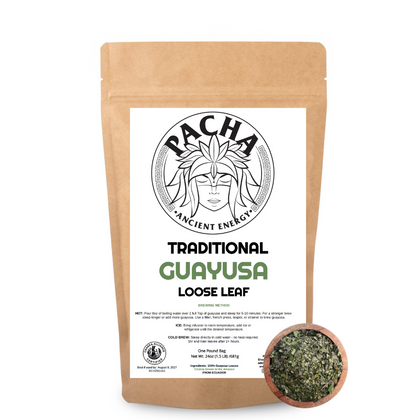
- Traditional: withered and dried, rich and bold, about 66 mg per 4 g.
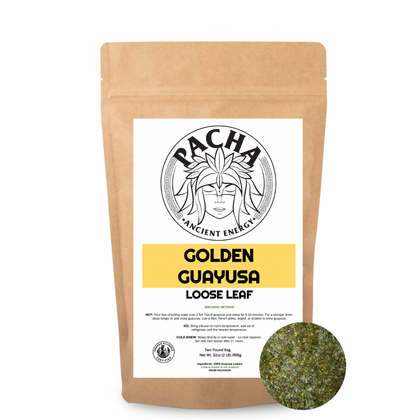
- Golden: dried without withering, smooth and mellow, about 52 mg per 4 g.
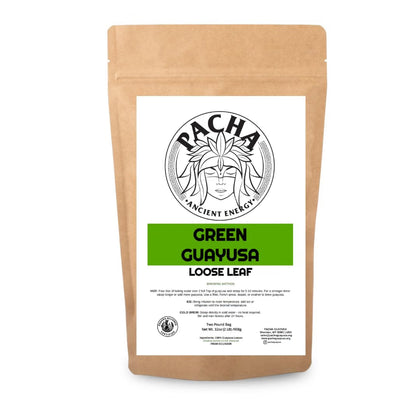
- Green: fresh and light, about 59 mg per 4 g.
And they come as loose leaf, tea bags, powder and instant, so you can brew a pot, drop a bag in a mug or blend a smoothie. Compare every option in our guayusa tea bags and loose leaf guayusa collections, or start with our everyday Guayusa Tea Bags – 100 Count.
A quick checklist
| Check | What a good label tells you | PACHA guayusa |
|---|---|---|
| Origin | Country, region and how it's grown | Archidona, Napo (Ecuador); chakra forest gardens |
| Drying | How it's dried; whether it's smoked | Hand-picked, air-dried and oven-dried; never smoked |
| Caffeine | Mg per serving and serving size | Stated for every product, e.g. ~66 mg per 4 g (Traditional) |
| Certification | A seal you can look up, and what it covers | Chakra Alliance: Trader (PACHA) and Producer (our producers) |
| Sourcing | Who grows it and how it's bought | Direct from small-scale farmers, no intermediaries |
| Variety & format | Clear variety names; the format you need | Traditional, Golden, Green; loose leaf, tea bags, powder, instant |
Comparing brands side by side
If you'd like to see many U.S. guayusa products in one place, the Guayusa Field Guide at guayusa.us lines them up by format, caffeine, origin and certification. <!-- ⚠️ Si guayusa.us es de Paul/PACHA, añadir aquí una línea que lo diga (FTC). --> Whatever you use, run the six checks above and confirm the details on each brand's own page. For our own range, see Guayusa Compared: Types, Formats and Brands.
Keep reading: What Is Guayusa? · How to Make Guayusa Tea · Guayusa vs Yerba Mate
Frequently Asked Questions
What is the best guayusa tea?
The best guayusa tea for you is one that tells you where the leaf comes from, how it's dried, how much caffeine is in each serving and how it's certified, in the variety and format you like. Use the six checks in this guide to compare any brand.
Is smoked or air-dried guayusa better?
It's a matter of taste, but they're different. Air-dried leaf tastes like the leaf itself; smoke adds its own flavor. Our guayusa is air-dried and oven-dried and never smoked.
Why does caffeine per serving matter?
Because guayusa products differ a lot. A 1.5 g tea bag and a teaspoon of powder can differ several times over in caffeine. Look for the milligrams and the serving size together; ours range from about 22 mg to about 120 mg depending on the product.
What does Chakra Alliance certification mean?
Chakra Alliance is a nonprofit that certifies family farms in Ecuador's Amazon against four pillars: conservation, biodiversity, fair work and natural farming without synthetic chemicals. Our producers are certified in chakra cultivation and hold Producer Certification and PACHA holds Trader Certification.
Which guayusa variety should I choose?
Traditional is rich and bold and has the most caffeine of our three varieties; Green is fresh and light; Golden is smooth and mellow. Choose tea bags for convenience, loose leaf to control strength, and powder to blend into drinks.
Sources
- FAO, GIAHS: "Amazonian Chakra" (Napo, Ecuador) — https://www.fao.org/giahs/giahs-around-the-world/ecuador-amazonian-chakra/en
- Chakra Alliance, certification standard — https://chakraalliance.org/certification.html
- U.S. Food and Drug Administration, "Spilling the Beans: How Much Caffeine Is Too Much?" — https://www.fda.gov/consumers/consumer-updates/spilling-beans-how-much-caffeine-too-much